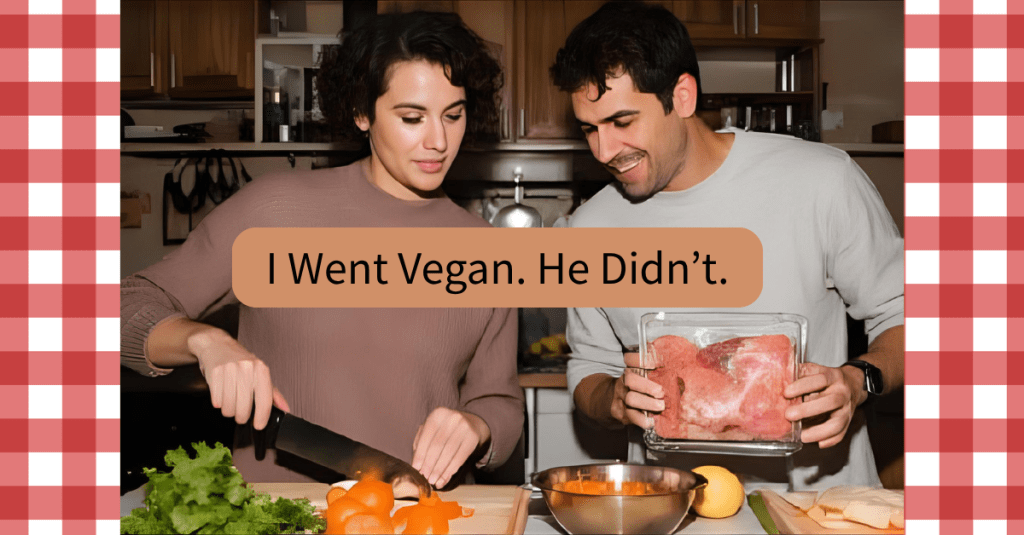
So you’ve watched the documentaries, maybe read a few books, and you’re starting to look at your fridge a little differently. You’ve got this pull in your heart—this quiet but persistent voice that says: It’s time.
You’re ready to explore a vegan lifestyle.
But then… you look over at the dinner table.
Where your partner is drowning a steak in butter.
And suddenly that voice in your head gets drowned out by another one:
“How am I going to make this work if they’re not on the same page?”
I see you.
I was you.
And in this blog, I’m going to walk you through how I handled it (spoiler: not perfectly), what I learned, what not to do, and the exact phrases you can use to keep things from turning into a food fight over the kitchen counter.
Whether your partner is supportive-but-uninterested or totally eye-rolling every time you say “plant-based,” this one’s for you.
My Story: The Moment It Got Real
When I first decided I wanted to go vegan, I was still a little wobbly.
I didn’t even call it “vegan” at first—I said things like:
- “I’m just experimenting with more plant-based meals.”
- “Trying to eat a little cleaner.”
- “Just doing Meatless Mondays…every day.” 😅
But inside, I knew this wasn’t just a diet trend for me. I’d seen the footage. I’d read the facts. I felt it in my bones: this mattered.
The problem?
My partner didn’t feel it in his bones.
He was supportive in that surface-level way:
“Do whatever makes you feel good.”
But then…
- He’d fry bacon in the morning while I was drinking a green smoothie.
- He’d grill burgers at a BBQ and say, “C’mon, you can have one bite.”
- And somehow cheese kept finding its way back into our kitchen, no matter how much I tried clearing it out.
At first, I was resentful. I didn’t want to be “that partner” who nags or controls. But I also didn’t want to feel alone in something that mattered so much to me.
That’s when I realized:
This isn’t about converting them—it’s about communicating clearly, loving deeply, and living in alignment with your values without burning the house down.
Step 1: Be Clear on Why You’re Doing This
Before you even start the conversation, get super clear with yourself:
Why do you want to go vegan?
Write it down. Journal on it. Get rooted.
Because when the meatloaf hits the fan (and it might), you’ll need to stay grounded in something deeper than “I heard it’s healthy.”
Here’s what I wrote in my journal when I was wavering:
“I’m doing this because I want to model compassion for our kids, feel better in my body, and live in a way that aligns with my values. I don’t need anyone’s permission to do that.”
Boom. That clarity is your superpower.
Step 2: Have the Actual Conversation
Let’s be honest—sometimes we hope they’ll just notice we stopped eating eggs and ask us about it over candlelight.
But most of the time, they’re just trying to figure out where the ketchup went.
So let’s talk scripts.
Here’s a gentle, open-hearted way to start:
Script #1: The Calm Opener
“Hey, there’s something I’ve been thinking about a lot, and I’d love to talk it through with you. I’ve been learning more about plant-based living and I really feel called to make a change for myself. I’m not asking you to change anything right now—I just want to share where I’m coming from.”
Script #2: The Empathy Sandwich
“I love that we don’t always have to agree on everything. This is something that’s becoming important to me, and I want to find a way to honor that while still making sure we’re both comfortable at home.”
Script #3: If They’re Defensive
“I get it—this probably sounds intense or sudden. I’m not saying you have to give up anything you love. I’m just trying to live in a way that feels more authentic to me. Can we talk about how to do that as a team?”
Notice the vibe here: It’s not pressure. It’s personal truth with respect.
Step 3: Get Creative With the Solutions
Now let’s talk logistics.
Because one of the biggest hurdles is the kitchen. And the grocery bill. And the “what the heck do we make for dinner now?” moment.
You don’t have to flip the whole house upside down. You just need a system.
Option 1: “Build-Your-Own” Nights
Taco night? Let them use ground beef, you use lentils or tofu.
Pizza night? Two crusts, two sets of toppings.
Buddha bowls? Everyone picks what goes in theirs.
Option 2: Cook Once, Customize Twice
Make a big base (like rice or pasta), and then each person adds their own protein and sauce.
I’d make a tomato-y red lentil sauce and keep a small pan aside for my partner to throw in his meatballs. I wasn’t cooking meat, but I wasn’t standing in the way either.
Option 3: Tag-Team the Week
You cook 3 nights your way, they cook 3 nights their way. The 7th is leftovers or takeout.
And guess what? Your partner may accidentally love your vegan chili. (Mine did.)
Step 4: Kid Conflicts? Here’s What Helped Us
One thing that really threw me was the kid factor.
Because let’s be honest—once kids are involved, the food choices suddenly feel like a battleground of parenting styles.
Here’s what worked for us:
- Let your partner choose one night a week to cook “their” meal. The rest can be plant-based or “choose your own.”
- Include your kids in grocery shopping or prepping vegan meals. It makes them more open and curious.
- Use kid-friendly phrases like:
- “These are plant-powered nuggets—they help you grow strong like a superhero!”
- “We’re trying foods that are kind to animals. Want to help me pick something fun for dinner?”
Also—this is big—don’t shame your partner in front of your kids.
Even if they’re making hot dogs again. Even if you’re cringing.
Keep the conversation between adults, and let your modeling speak louder than your words.
Step 5: Know When to Let It Go
You don’t have to win every dinner.
You don’t have to “convert” anyone.
You do have to honor your own values and communicate them lovingly.
At one point, I sat on the couch and said:
“Look—I know you may never go vegan. That’s okay. But this is important to me. And I hope we can create a home where we both feel respected in our choices.”
That was the turning point.
Not because he changed.
But because I did.
What If They Never Get On Board?
Then you go vegan anyway.
Seriously.
You don’t need a household conversion to start.
You need clarity, commitment, and some creative systems.
You can raise plant-based kids in a mixed-diet household.
You can model values without demanding change.
You can still connect deeply with your partner—because love isn’t about identical dinner plates. It’s about mutual respect, growth, and supporting each other’s evolution.
Final Thoughts: You’re Not Alone
If you’ve been feeling alone in this—like you’re carrying this big shift on your own—I just want to say:
You are not the only one.
I’ve worked with so many vegan-curious moms who are on this exact path.
And guess what? Many of their partners eventually came around. Not because they were forced—but because they were inspired.
But even if that never happens, you can still thrive.
You can still make changes.
You can still raise your kids with compassion.
And you can still love your partner fully while honoring yourself.
That’s what real transformation looks like.
If this blog hit home for you, share it with a fellow mom who’s quietly trying to navigate this same path. You never know who’s secretly Googling “how to go vegan with a meat-loving partner” at midnight. 😉
You’ve got this, mama.
One meal, one choice, one conversation at a time.
 Kristyn Medeiros