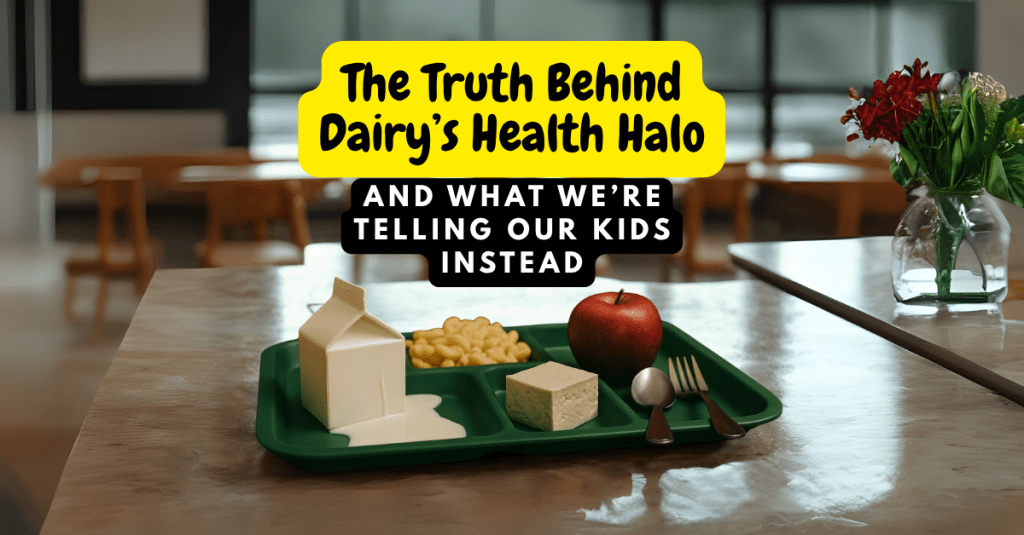
The Truth Behind Dairy’s Health Halo—and What We’re Telling Our Kids Instead
If you grew up in the U.S. any time after the 1980s, you probably remember the ads: celebrities with milk mustaches, lunch trays with cartons of 2%, and the reassuring promise that milk makes your bones strong.
“Milk—it does a body good,” they told us.
“Got Milk?” they asked—with just enough sass to make us want to say yes.
So if you’re a vegan-curious mom wondering why not drinking milk feels like going against the grain, there’s a reason for that—and spoiler alert: it’s not because your body actually needs it.
It’s because you’ve been sold it.
In this blog, I want to pull back the curtain on the dairy industry’s decades-long PR campaign. We’re going to talk about:
- The real history behind milk’s rise in American culture
- Why the government made milk a staple (hint: 💰)
- How that impacts what our kids are taught in schools
- And how to confidently explain the truth to your kids without sounding like a conspiracy theorist
Let’s unpack the moo-nipulation (yep, I went there 😉).
So… Why Is Milk Everywhere?
Let’s rewind to the early 1900s.
Back then, milk was perishable, hard to store, and not yet pasteurized. It wasn’t in every home fridge or school lunch tray—it was more of a local product, often delivered straight from nearby farms.
Then came the rise of industrial agriculture, World War I, and the growing desire to support American farmers. By the time World War II rolled around, the U.S. government was deep into promoting milk production—not because it was magical, but because it was profitable. They needed a way to store surplus milk, so they made cheese and powdered milk. They had too much, and they had to sell it.
So what did they do?
They started subsidizing the dairy industry—pouring government dollars into dairy farms, equipment, and marketing. That way, farmers could keep producing more and more milk, and the government would help sell it.
Which brings us to the most powerful tool of all: advertising.
Enter: Got Milk? The Ad That Became a Movement
In the 1990s, the California Milk Processor Board launched the “Got Milk?” campaign, which quickly went national. Suddenly, every A-list celebrity, cartoon character, and athlete was smiling back at you with a creamy white mustache.
It wasn’t just a campaign. It was a cultural moment.
And behind that campaign? Millions of dollars from the dairy industry and U.S. government partnerships. These ads were designed to associate milk with power, health, and being cool. (I mean, if Britney Spears drinks milk, shouldn’t we?)
But here’s the thing no one told us as kids:
These weren’t health campaigns. They were sales campaigns.
The goal was to sell milk, not to keep us healthy. And it worked.
But Isn’t Milk Healthy?
Okay, let’s pause. Because I know what you might be thinking:
“But isn’t milk a good source of calcium and protein?”
Yes… and no.
Milk does contain calcium, but so do tons of plant-based foods—like kale, tahini, white beans, fortified plant milks, tofu, and almonds. And yes, milk has protein—but again, so do lentils, quinoa, oats, soy, and nut butters.
The difference?
Milk also comes with saturated fat, hormones, and for many people, digestive issues (hello, lactose intolerance—over 60% of the world can’t properly digest cow’s milk).
And yet… we still see milk as this sacred health food.
Why?
Because we’ve been taught to think that way—by people who profit from it.
Follow the Money: The Dairy Subsidy Breakdown
This is where it gets wild.
In the U.S., dairy is one of the most subsidized agricultural industries. In 2020 alone, American dairy farmers received over $2.9 billion in federal aid.
That’s not money going to make milk healthier. That’s money helping the dairy industry stay afloat—even as more and more people are turning to plant-based alternatives.
What does this mean for us?
- It means milk stays artificially cheap, even when demand drops.
- It means schools are required to offer cow’s milk to receive federal lunch funding (even if kids don’t drink it).
- And it means you’re paying for milk with your taxes—whether you drink it or not.
Honestly? It’s frustrating. Because when something is government-backed, it feels legitimate. It feels like truth. But in this case, it’s just good lobbying.
What This Means for Our Kids
Let’s talk about the classroom for a second.
Most school lunches include milk by default—usually dairy milk, rarely plant-based. Some kids get gold stars for drinking it. Others are made to feel “weird” for skipping it.
And when your kid comes home saying,
“My teacher said I need milk for my bones,”
it’s not because they’re trying to shame your family. It’s because they’re repeating what they were taught.
This is why it’s so important for us—vegan-curious and vegan-confident moms alike—to know the truth and be ready to gently challenge the script.
You don’t have to go full tinfoil hat. You just have to be calm, informed, and real.
How to Talk About This with Your Kids (Without Making It Weird)
Here are some phrases I use in my own home when the milk talk comes up:
✅ When your kid asks:
“Why don’t we drink milk like other kids?”
You can say:
“A long time ago, people thought milk was the best way to grow strong. But now we know there are lots of ways to build strong bones—like with almond milk, tofu, and beans. We just choose the ones that feel best for our bodies.”
✅ When your kid says:
“My friend says milk is the only way to get calcium.”
You can say:
“That’s a super common idea. There’s a lot of advertising that makes it seem that way. But actually, calcium is in a ton of other foods. Let’s look at a few together!”
(Pro tip: Make a fridge list of “Plant Power Foods” your kids helped pick.)
✅ When you’re talking to other parents or teachers:
“We’re doing plant-based in our home, so we stick with fortified non-dairy milks. There are actually tons of options with just as much calcium and none of the digestive issues.”
A Quick Reality Check (Before You Start Feeling Like a Rebel)
If you feel overwhelmed, just know this:
You are not the only one.
More and more families are starting to ask why they’re told they “need” milk, and the answers almost always come down to money—not health.
It’s okay to be curious. It’s okay to unlearn old ideas. And it’s more than okay to teach your kids to do the same.
What We’re Teaching Our Kids Instead
In our house, we keep it simple:
- We eat food that makes us feel good.
- We choose kindness—for animals, our bodies, and the planet.
- We ask questions—even if they challenge what everyone else is doing.
If that’s your vibe too, welcome. You’re in good company.
Because being a vegan-curious mom doesn’t mean you have all the answers. It means you’re willing to look for better ones. Ones that come from truth, not tradition.
Want Help Explaining All This in Kid-Sized Bites?
I’ve got you, mama. 💚
Download the Vegan Confidence Kit for Families—a free guide packed with:
- Kid-friendly answers to big questions about animal products
- Lunchbox swaps your kid won’t trade away
- My favorite plant-based milk options (including ones with calcium + D3)
- And a bonus cheat sheet on how to talk to teachers, friends, and in-laws 😅
👉 Click here to grab your free kit now.
You don’t have to be an expert. You just need to know enough to start the conversation—and trust me, you’ve already got what it takes.
P.S. Just because something is “normal” doesn’t mean it’s right. And just because it’s “everywhere” doesn’t mean it belongs in your cart. You’re doing something powerful by even questioning it—and your kids are watching. 💪
 Kristyn Medeiros