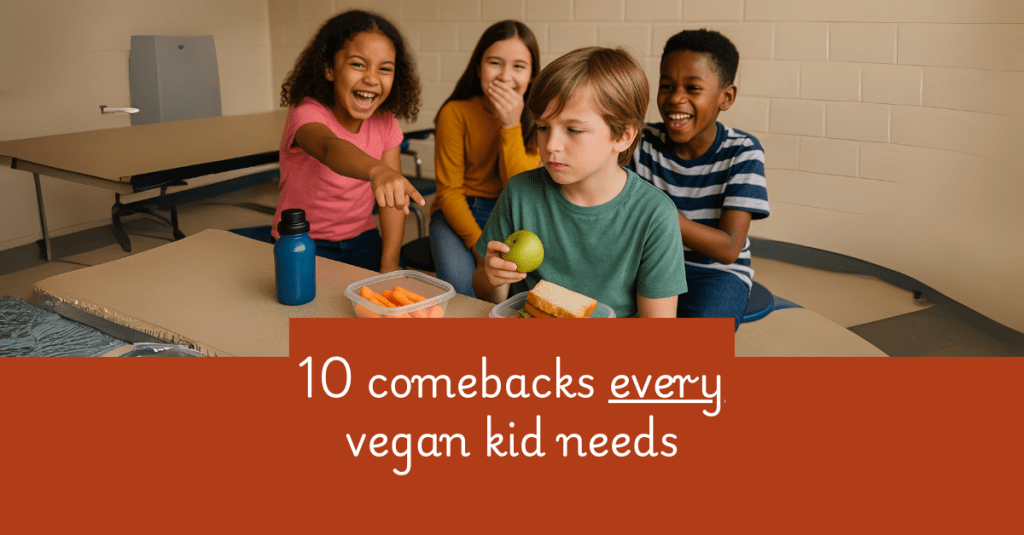
Picture this: your kid opens up their carefully packed lunch—a rainbow of fresh fruit, a hummus wrap, maybe even those homemade vegan cookies you stayed up too late baking—and before they can even take a bite, a classmate blurts out:
“Ew, that looks weird!”
“Is that all you eat? Rabbit food?”
“You don’t eat chicken nuggets? That’s so dumb!”
Your kid’s face drops. The fun of lunchtime vanishes. And in your heart, you’re wishing you could be right there to swoop in and say something—anything—that makes them feel strong again.
Here’s the good news: you can’t always control what other kids say, but you can equip your child with the confidence and language to handle it. This isn’t about teaching them to be sassy or mean—it’s about giving them tools to stand tall, keep their dignity, and maybe even surprise everyone with a little humor.
Because here’s the truth: food teasing happens. But every “Ew, that’s gross” is actually an opportunity for your kid to practice confidence.
Why Kids Need Tools (Not Just “Ignore Them”)
You’ve probably heard the advice: “Just ignore it.” And yes, sometimes ignoring is powerful. But kids need more than that. They need choices. They need to feel like they have a script to reach for when their brain freezes in the moment.
Think of it like this: when kids rehearse comebacks in a safe space (like your kitchen table), they’re less likely to crumble in the cafeteria. Instead, they’ll feel empowered to respond—without aggression, without shame, and without shrinking.
The Confidence Equation
Here’s the mindset piece you’ll want to remind your child of (and maybe yourself too):
- Their vegan lunch isn’t “weird.” It’s just different.
- Different makes people curious—and sometimes curiosity comes out as teasing.
- They don’t need to convince anyone. They just need to stand confidently in who they are.
10 Kid-Friendly Comebacks
I’ve broken these into three categories—so your child can pick what feels natural in the moment. Practice them together at home, maybe even role-play during dinner (kids love this—it feels like a game!).
Category 1: The Light & Funny
Perfect for diffusing tension and making kids feel clever instead of defensive.
- “At least my lunch didn’t have a face.”
→ Short, funny, and to the point. - “Don’t knock it till you try it!”
→ Flips the script and puts the other kid on the spot (in a playful way). - “That’s okay—more for me!”
→ Shows zero shame and makes teasing fall flat.
Category 2: The Confident & Calm
For when kids just need to stand tall and own it.
- “I actually like it this way.”
→ Simple, confident, and unshakable. - “This is normal for me.”
→ A reminder that “normal” is subjective. - “My food makes me happy.”
→ Hard to argue with happiness.
Category 3: The Values-Based
For kids who feel ready to share a little bit of their “why.”
- “I like that my food is kind to animals.”
→ Gentle but powerful. - “I eat this way because it’s healthy for me.”
→ Centers the conversation on health, not judgment. - “Everyone’s lunch looks different. This one’s mine.”
→ Neutral, inclusive, and shuts the door on further debate. - “Yep, I’m vegan—and I’m proud of it.”
→ The ultimate confidence line.
Teaching the 3 Response Tools
Along with comebacks, teach your child these three strategies:
- Ignore it. Sometimes silence really is the strongest move.
- Deflect with humor. A quick one-liner keeps things light.
- Own it with confidence. Stand tall and say it like it’s no big deal.
By giving them options, you’re handing them control. And that’s what builds resilience.
How to Practice at Home
Here’s a fun exercise:
- During dinner, you play “the teaser” and toss out lines like “Ew, that looks weird.”
- Your child gets to pick a comeback—funny, calm, or values-based.
- Then switch roles and let them tease you about your meal (kids LOVE this).
The goal isn’t to create little debaters. It’s to make responses second nature. So when the moment comes at school or a party, they don’t freeze—they respond.
Why This Matters Beyond Food
Here’s the deeper layer: this isn’t just about vegan lunches. This is about teaching your kids how to handle being “different” with confidence. Today it’s food, tomorrow it’s a hobby, a belief, or a choice they make that not everyone understands.
Every time they practice standing tall, they’re building muscles of resilience, kindness, and self-trust. And honestly? That’s the kind of skill set every mom wants for her kids.
Bringing It Back to Your Why (for Moms)
On the hard days, when you worry your child might feel left out, remember this:
- You’re raising kids who know how to think for themselves.
- You’re giving them the courage to stand up for their values.
- You’re showing them that kindness and confidence can coexist.
That’s bigger than food. That’s character.
Wrap-Up: The Real Win
So the next time your kid opens their vegan lunch and hears, “Ew, gross!”—don’t panic. Picture them smiling, shrugging, and saying one of these comebacks with confidence.
The win isn’t silencing other kids. It’s your child walking away from the lunch table still proud of who they are.
Want more ways to empower your kids (and yourself) for the vegan journey? Grab my free Vegan Family Confidence Kit—filled with scripts, mantras, and simple strategies that make standing tall as a vegan family feel second nature.
 Kristyn Medeiros